
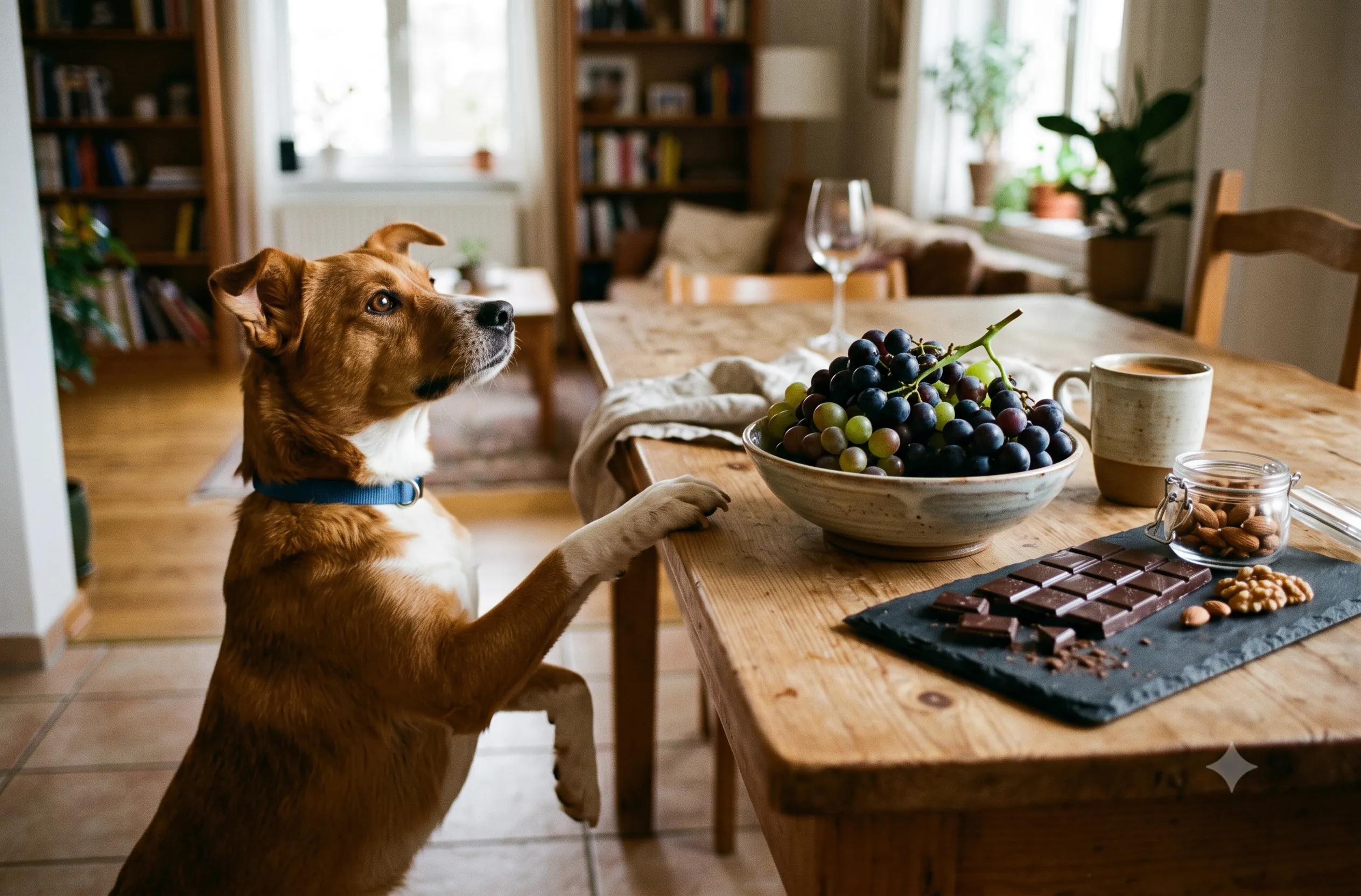
Many beginner caregivers assume that if a food is safe for people, it should also be safe for a dog or a cat. In reality, pets process some compounds differently, and that is why very common household foods can cause anything from digestive upset to serious poisoning. The risk is not determined only by whether the food looks "natural" or "homemade". It also depends on how that ingredient acts in the animal's body, how much was eaten, and the pet's size, age, and health status.
That is why prevention is usually more useful than improvising later. Knowing which foods should stay out of reach helps people make safer decisions in the kitchen, during family gatherings, or when leftovers are shared without much thought. For someone who is just starting to care for a pet, this information is not meant to create alarm. It is meant to provide a clear base for avoiding common mistakes and recognizing when a situation calls for prompt veterinary attention.
Why some human foods can be dangerous
Dogs and cats do not metabolize every ingredient the way people do. Some substances can affect the nervous system, the liver, red blood cells, or blood sugar balance even in small amounts. The same food may also create different levels of risk depending on the species. A dog is often more willing to eat a wide range of foods, while a cat may be more selective, but that does not make the cat safe if it eats an unsuitable ingredient.
Context matters too. A pet licking a trace is not the same as eating a full portion, getting into trash, or swallowing concentrated foods such as raw dough, sweets, or sauces. At home, many poisoning cases begin with ordinary oversights: a poorly closed bag, food left on a table, a guest offering a treat, or a baked product that seems harmless. Seeing the issue this way helps frame it less as a rare accident and more as a basic prevention habit.
Common toxic foods worth knowing
Several everyday foods are repeatedly mentioned in veterinary prevention guidance. Chocolate is one of the best known, especially darker and more concentrated types, because it contains compounds that may affect the nervous system and the heart. Grapes and raisins are also considered concerning, since they may be associated with severe problems in some dogs even when the amount seems small.
Onion, garlic, and related vegetables may be harmful because they can affect red blood cells. This does not apply only when they are offered raw. The same risk may exist in sauces, broths, cooked dishes, and seasoned leftovers. Another important group is products that contain xylitol, a sweetener found in chewing gum, candy, some peanut butters, and other processed foods. In dogs, this ingredient can cause a sharp drop in blood sugar and calls for a rapid response.
Alcohol, coffee, energy drinks, and other products with caffeine are not appropriate either. Even if the pet does not drink them directly, access may happen through doughs, desserts, or poorly supervised containers. Macadamia nuts are also described as problematic for dogs. Added to that are raw doughs with yeast, cooked bones that may splinter, and very fatty or heavily seasoned foods, which are not always "toxic" in exactly the same sense but can still trigger digestive complications or make a risky situation worse.
Warning signs after accidental ingestion
Signs of poisoning do not always appear immediately, and they do not look the same in every animal. Some pets develop vomiting, diarrhea, heavy drooling, abdominal pain, or refusal to eat. Others show restlessness, weakness, tremors, poor coordination, or a marked change in their usual behavior. When exposure is more significant, breathing difficulty, collapse, or seizures may also appear.
For a beginner caregiver, the key point is not to guess the exact severity at home. The useful step is to recognize that a risky food plus abnormal symptoms is enough reason to seek help. It also matters to remember that a lack of symptoms in the first few minutes does not prove that everything is fine. Some effects take time to appear, and waiting until the pet gets worse can make later management harder.
What to do if your dog or cat ate something dangerous
The first useful step is to remove the food, keep the packaging if there is any, and estimate as well as possible what the pet ate and when it happened. That information can guide a veterinarian. It also helps to note the pet's approximate weight, species, age, and any symptoms already present. The more concrete the information, the easier it is to judge how urgent the situation may be.
It is not a good idea to induce vomiting on your own or offer home remedies without professional guidance. What sometimes circulates as a quick fix may be ineffective or may worsen the situation. In a suspected food poisoning case, the reasonable response is to contact a veterinary clinic as soon as possible and follow its instructions. If the professional recommends coming in right away, delaying the visit just to "watch a little longer" is usually not a sound choice.
How to prevent food poisoning at home
Prevention starts with how the environment is organized. Keeping chocolate, grapes, onion, garlic, sweets, and sweetened processed foods in closed cupboards reduces risk substantially. It is also worth checking bags, backpacks, low tables, and trash bins, because many exposures happen outside formal meal times. In homes with children or frequent visitors, it can help to say clearly that leftovers and treats should not be offered without asking first.
Another practical step is to separate the idea of "sharing food" from the idea of "caring well". For many people, giving a small bite feels affectionate, but with pets that habit can create unnecessary risks and also reinforce begging at the table. Keeping pet-formulated treats available and knowing in advance which ingredients should be avoided makes it easier to act with more judgment and less improvisation.
Common mistakes when judging risk
One of the most common mistakes is believing that a food is only dangerous if the pet becomes seriously ill right away. In reality, some poisoning cases begin with mild or delayed signs. Another mistake is assuming that a small amount is always irrelevant. With certain ingredients, the safety margin can vary widely from one animal to another, and it is not always wise to dismiss the exposure without asking for guidance.
People also often confuse the idea of "toxic" with the idea of "hard to digest". Not every unsuitable food causes poisoning in the strict sense, but that does not make it a good choice. For a beginner caregiver, the safest rule is often simple: if you do not know for certain that a product is appropriate for that species and in that amount, do not offer it, and ask for advice if the pet has already eaten it.
When to seek veterinary help without waiting
If you know the animal ate chocolate, grapes, raisins, onion, garlic, xylitol, alcohol, caffeine, or another clearly risky food, it makes sense to seek advice immediately even if no obvious signs are present yet. The same level of urgency applies when the pet is very small, has previous health problems, is elderly, or ate an unknown but potentially important amount.
It is also reasonable to act without delay when there is repeated vomiting, tremors, marked weakness, disorientation, breathing difficulty, or any abrupt change in general condition. In these situations, time is often more valuable than continued observation at home. The most useful recommendation for beginners is not to memorize every clinical scenario, but to assume that a dangerous food plus abnormal signs makes early veterinary consultation the most prudent option.
FAQ
Do cats face the same risk as dogs with every toxic food?
Not always. Some foods are reported more often in dog poisoning cases because dogs tend to eat with less selectivity and take advantage of almost any accessible leftover. Even so, that does not mean cats are protected. Cats can also suffer important consequences after eating unsuitable ingredients, especially when those ingredients are present in sauces, flavored dairy products, doughs, sweets, or kitchen leftovers.
The practical difference for a caregiver should not be overconfidence, but a better understanding that each species has its own vulnerabilities. If a food is considered dangerous for pets, the safest approach is to avoid it entirely for both and to contact a veterinarian after any doubtful ingestion, even if the cat ate a smaller amount or does not show immediate symptoms.
What should I do if I do not know how much my pet ate?
When the amount is unclear, it is better to act as if the exposure could matter, especially if the food involved is one of the higher-risk items. Keeping the packaging, estimating how much was missing before and after, and checking for wrappers or leftovers can give the veterinarian a more useful reference. Even an imperfect estimate is still better than waiting without any concrete information.
In these cases, uncertainty should not delay the call. Precisely because the amount is unknown, it is harder to decide from home whether the situation is minor or potentially serious. The prudent step is to describe the food, the animal's size, the likely time of ingestion, and any changes you have noticed, then let the professional guide the next steps.
Does it make sense to wait a few hours and see whether symptoms appear?
Waiting may feel reasonable when the pet seems normal at first, but it is not always the best option. Some toxic exposures take time to produce visible signs, and losing time can reduce the value of early action. By the time symptoms appear, the situation may already be more advanced than it was during the first minutes after ingestion.
For beginner caregivers, the most practical rule is this: if the food is clearly risky, ask first and decide afterward with professional guidance. Watching at home only makes sense when a veterinarian already knows the case and has specifically told you what signs to monitor and how long to monitor them.