
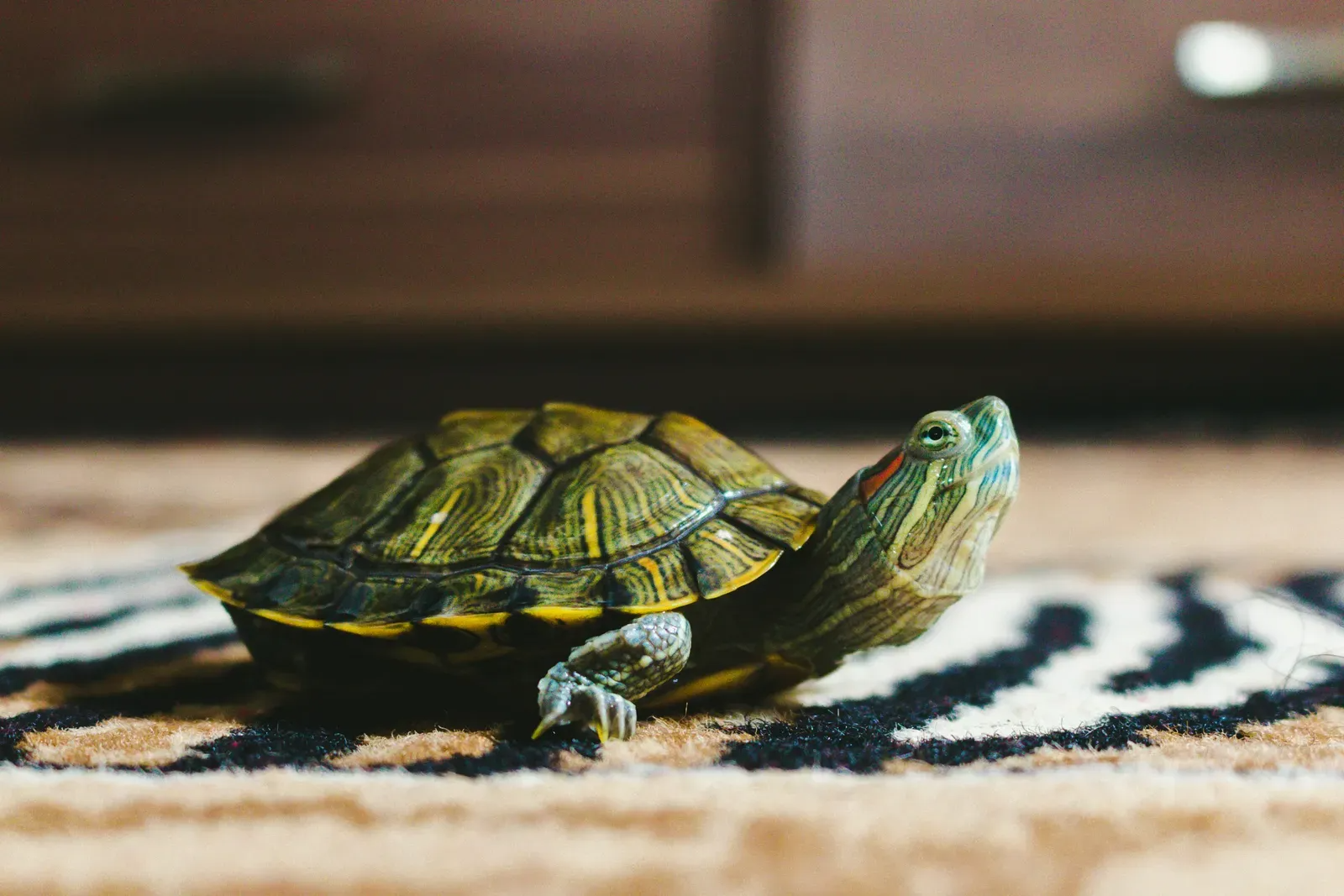
When a turtle stops eating, the first reaction is often to treat food as the only problem. In many cases, though, appetite is linked to something broader: environmental changes, inadequate temperature, unstable handling, or a routine that shifted before the caregiver noticed it clearly. That is why observation is usually more useful than improvisation at the start.
For a beginner, the practical goal is not to force food intake or change everything at once, but to review what has changed and which other signs appear alongside the lack of appetite. An aquatic turtle and a land turtle do not live under the same conditions, but in both cases the surrounding context affects feeding behavior.
What to check first if a turtle is not eating
Before thinking about complex causes, it helps to check the basics. The first point is to confirm how long the turtle has been eating less and whether it has stopped completely or is only eating less than usual. Sometimes the problem is not a total refusal, but a gradual drop that becomes obvious only after several days.
It also matters to notice whether anything else has changed at the same time. For example, less activity, more time hiding, weaker response to the environment, or changes in movement. Appetite is rarely understood well when it is looked at in isolation from the rest of the animal's behavior.
Another useful step is to review recent changes: new food, more aggressive cleaning of the enclosure, a move to another tank or terrarium, temperature fluctuations, less light exposure, or more handling than usual. In animals that depend so strongly on environmental stability, small changes can have more impact than expected.
Common causes related to food and environment
One of the most common causes is that the environment is not supporting the turtle's normal activity. Temperature has a strong effect on metabolism, and when it is not appropriate the turtle may become less active and less willing to eat. The same can happen when the resting area, the water, or the overall enclosure conditions are unstable.
Food can also play a role, but not always because there is too little of it. Sometimes the problem appears after a new food is introduced, when the overall offering is too limited, or when food is presented in a way the turtle does not recognize well. In other cases, what looks like food refusal may simply coincide with an environment so altered that the animal is not in a normal state for feeding.
Environmental stress is another frequent factor. Abrupt changes, excessive handling, constant noise, poorly resolved cohabitation, or a low sense of security inside the enclosure can affect appetite. That is why, when a turtle stops eating, it helps to review not only what food is being offered, but also what the animal is experiencing around that food.
Basic differences between aquatic and land turtles
With an aquatic turtle, checking the water and temperature usually carries special weight. If the water is outside a suitable range, dirty, or part of an environment that does not support a stable pattern of activity and rest, appetite may be affected fairly quickly. It also matters that the turtle has a functional dry area and consistent light and heat conditions.
With a land turtle, attention often shifts more toward the general thermal environment, shelter availability, light, and the way food is offered. Even though both types are sensitive to environmental change, the way each one reacts to its conditions is not identical.
That is why, in a general guide for beginners, it is safer not to assume that what applies to an aquatic turtle will apply in the same way to a land turtle. The shared principle is to review basic conditions and avoid impulsive changes, but the specific observation should still be adapted to the type of turtle being cared for.
What a beginner can do at home without improvising
The first goal is to restore stability. If several changes happened recently, it helps to stop adding more variations and review the environment with some order: temperature, light, cleanliness, easy access to food, and the general level of calm. The goal is not to "do more things", but to keep the problem from becoming harder to interpret through disorganized intervention.
It also helps to offer the usual food under consistent conditions and observe the response without forcing the issue. Changing food every few hours, handling the turtle continuously, or trying to solve the problem through insistence alone usually adds confusion rather than clarity. Structured observation is often more useful than anxious reaction.
Another practical step is to keep a short record over several days: how long the turtle has gone without eating, whether it drinks or moves normally, whether there are visible changes in overall condition, and which environmental checks have already been made. That information can improve home care and also becomes useful if professional guidance is later needed.
When it is no longer a minor issue
A turtle not eating does not always mean an immediate emergency, but it stops being a minor issue when the appetite loss persists, appears together with other noticeable changes, or coincides with a clear decline in general condition. Lower activity than usual, weakness, changes in the eyes or shell, unusual breathing, or difficulty staying active all deserve attention.
It is also wise to act more carefully if no obvious environmental or feeding factor seems to explain the change, or if basic corrections do not lead to any improvement. The goal is not to panic over every brief variation, but also not to normalize a persistent lack of appetite.
When the problem lasts or comes with other signs, the more reasonable step is to seek professional guidance. Home care can help detect patterns and organize observation, but it should not replace expert assessment once the situation stops looking simple.
FAQ
Can temperature make a turtle stop eating?
Yes, it can matter a great deal. Turtles depend heavily on the thermal conditions of their environment to maintain normal activity. If the temperature is not appropriate, metabolism may slow and the animal may become less active and less willing to eat.
That is why, when a turtle stops feeding, one of the first useful checks is often the thermal environment. The point is not just to look at one number, but to assess whether the overall conditions support a normal pattern of rest, movement, and feeding.
Should I change the food right away if my turtle stopped eating?
Not always. The impulse to change food quickly usually comes from wanting to solve the problem as fast as possible, but it can also add more variability to a situation that is already hard to interpret. If the environment changed or the turtle is stressed, the issue may not be the food itself.
It is often more useful to review what has changed around the animal first and keep the food offering stable while watching the response. If too many things are changed at once, it becomes harder to understand what was really affecting appetite.
Are there important differences between an aquatic turtle and a land turtle if they stop eating?
Yes, because the context they live in is not the same. In an aquatic turtle, more attention usually goes to the water, temperature linked to that water, and the balance between aquatic and dry areas. In a land turtle, the general thermal environment, light, shelter, and the way food is offered often matter more.
That does not mean they are completely separate cases, because both depend strongly on environmental stability. The difference is mainly where it makes sense to look first and which factors are more likely to alter feeding behavior.
When should you seek professional help if a turtle is not eating?
It makes sense to consider it when the lack of appetite persists, when it appears together with other clear changes in activity or overall appearance, or when basic environmental checks do not help explain what is going on. Waiting too long can make the situation harder to assess calmly.
Professional help is also reasonable when the caregiver cannot tell whether the problem is minor or whether there are signs that go beyond a simple environmental adjustment. In those cases, asking for guidance is not overreacting. It reduces the risk of overlooking something important.