
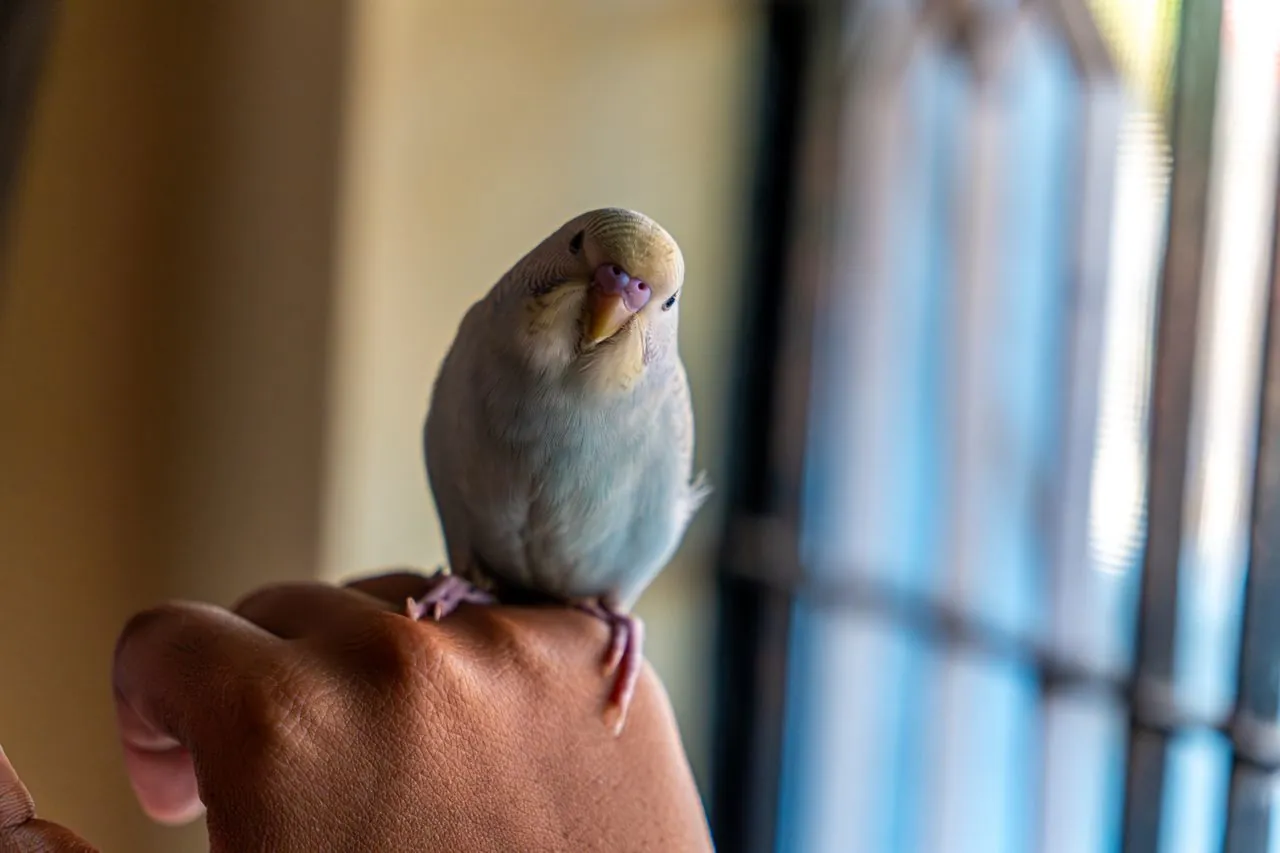
Helping a budgie trust a person is rarely about finding one quick trick. It is usually the result of many safe and predictable experiences. For many birds, the human hand is intimidating at first. It comes from above, takes up a lot of space, and if it moves too quickly it can feel threatening. That is why beginner caregivers who try to speed things up by touching or grabbing a budgie too soon often make the process move backward instead of forward.
The good news is that trust can be built. A budgie can learn to tolerate human presence, approach voluntarily, and eventually step onto a hand if the environment, pace, and expectations are appropriate. The aim is not to dominate the bird or force physical contact, but to make the interaction feel safe enough that the choice to come closer belongs to the budgie. That difference changes the entire training approach.
Start with the environment before the hand
Before asking for any behavior, it helps to check whether the budgie feels reasonably safe in its space. A poorly placed cage, a noisy setting, constant movement, or a lack of routine can make trust much harder to build. If the bird is still adjusting to the home or startles every time someone appears, asking it to step onto a hand too early is usually asking for more than it can handle.
For a beginner caregiver, this phase may look passive, but it matters. The budgie needs to learn that the person appears predictably, changes food and water without chasing, speaks in a steady tone, and does not invade the space unnecessarily. Very often, the first real sign of progress is not that the bird comes closer, but that it stops moving away every time someone passes near the cage.
Which signs show that trust is not there yet
Reading body language prevents many mistakes. A budgie that moves to the back of the cage, narrows its body shape, clings to the bars, freezes with tension, or flutters at the sight of a hand is not ready for a harder step. It also helps to notice whether the bird stops eating when a person comes close or only moves once the caregiver walks away. These signals do not mean the bird cannot be trained. They mean the current pace is too intense.
Trust begins to form when the opposite small changes appear: the budgie keeps its posture, continues eating, turns its head to observe without fleeing, vocalizes normally, or remains on a nearby perch while the person is present. To a beginner, these details may look minor, but they are the foundation for later training. Ignoring them often leads to misreading progress.
Helping the budgie get used to your presence
The next step is simple and not very dramatic: spend time nearby without asking for anything. Sitting by the cage, speaking softly, reading, or doing a calm activity helps the bird discover that human presence does not always bring sudden change. The goal is not to force attention, but to become a stable part of the environment.
Short sessions usually work better than long, tense attempts. Five or ten minutes several times a day can be more useful than one long session in which the bird becomes overwhelmed. If the budgie looks more relaxed as days pass, there is now a basis for more specific approaches. If it still stays highly alert or avoids any closeness, it makes sense to keep this phase going longer before insisting.
Using food as support without turning it into pressure
Many caregivers use a safe favorite food, such as millet spray, to make approaching easier. Used well, it can help a great deal because it creates a positive association with the hand. The problem starts when food is used to corner the bird or force it to choose between fear and giving up access to something appealing. Useful reinforcement does not push. It invites.
At first, it may be enough to offer the food near the cage or hold it from outside so the budgie can come only as close as it feels able to. Later, if the bird responds calmly, the food can be offered at the door or with a still hand inside the space, always at a distance that does not trigger escape. The right criterion is not moving the hand as close as possible. It is keeping the hand where the bird can still think and choose.
Moving the hand closer gradually
Once the budgie tolerates presence well and accepts food nearby, the hand can become a more direct part of training. Movement should be slow and soft, avoiding a direct entry from above like a predator. Many birds respond better when the hand stays still and visible than when it tries to follow them around the cage.
At this stage there is no need to ask for stepping yet. Sometimes the progress is simply that the budgie stays on the same perch while the hand is nearby. Other times it may accept taking one or two steps toward food held between the fingers. If each session ends before a strong startle happens, the bird collects manageable experiences and trust becomes easier to strengthen.
Teaching the step onto the hand
The moment to ask for stepping up usually comes when the budgie is already approaching on its own and no longer flees at the sight of fingers inside the space. A finger or steady hand can then be placed low against the chest area as a clear surface to move onto, while a calm motivator is offered in front. The point is not to push or keep tapping insistently, but to present an easy option the bird can understand.
Some budgies will step up quickly and others will need several sessions before placing even one foot. Any small progress counts. If the bird only touches with one foot and then pulls back, it is already practicing. Forcing a full step-up at that moment can damage the trust that has been built. In basic bird training, consistency usually matters more than speed.
What to do if the budgie gets scared and regresses
Setbacks are part of the process. A sudden noise, a bad experience, a room change, or a session that asked for too much can make the budgie become wary again. That does not mean all the work is lost, but it does mean it is time to return temporarily to an easier step. Pushing right after a scare usually makes things worse.
The most useful response is simple: create more distance, lower the demand, and go back to reinforcing calm behavior. If the bird once again accepts a person near the cage, that is the correct place to restart. Budgie training rarely moves in a straight line. Thinking of it as a staircase with repeated steps rather than a race helps keep expectations realistic.
Common mistakes that slow trust down
One of the most common mistakes is trying to grab the budgie by hand so it gets used to being handled faster. In practice, this usually teaches the opposite lesson: that the hand is something to escape from. The process is also delayed by tapping the perch to force movement, chasing the bird inside the cage, or extending sessions after clear signs of tension have already appeared.
Another common mistake is changing the goal every day. One day the person wants the bird to step onto a finger, the next to eat, and the next to come out of the cage. That mix can make learning confusing. For beginners, one very specific goal per phase usually works better: first tolerate presence, then approach food, then accept the hand nearby, and finally step up voluntarily.
When it makes sense to ask for help or review the approach
If the budgie has been in the home for a long time and still reacts with intense fear to any human presence, it may be necessary to review the environment, health, or previous history of the bird. An animal that is not eating well, is ill, or lives in a highly stressful setting will have more difficulty training. In those cases, the issue is not always the technique itself, but the foundation from which training is being attempted.
It also makes sense to seek guidance if the caregiver cannot tell the difference between a normal pause and an excessive level of fear. Sometimes an outside perspective helps adjust distance, pace, or expectations. The goal is not to make every budgie respond the same way, but to build an interaction that is safe, stable, and voluntary for that specific individual.
FAQ
How long does it take for a budgie to trust a person?
There is no fixed timeline. Some budgies show curiosity within a few days and others need weeks or longer before they feel secure enough. Age, previous history, environment, and caregiver pace all influence how quickly the process moves.
What matters is not measuring progress only by whether the bird already steps onto the hand. If it stops fleeing, eats normally near the person, or stays relaxed on a nearby perch, those are already useful signs of progress. When those steps are respected, trust tends to build more solidly.
Should I take the budgie out of the cage to train it better?
Not necessarily at the beginning. If the budgie still fears the person, opening the cage and asking for interaction can add too many variables at once. In many cases, basic training is easier to start inside the cage or at the doorway, where the bird still has a familiar spatial reference.
Once more trust exists and the outside environment is safe, out-of-cage work can be introduced gradually. But skipping the early phases often creates more escapes, more stress, and more difficulty rebuilding a calm routine.
What should I do if my budgie gets scared every time I move my hand closer?
The first step is to stop using that distance as the starting point. If the budgie gets scared every time, the hand is entering too fast or too close. Returning to an earlier phase is not failure. It is simply adjusting training to the bird's real comfort level.
From there, it helps to rebuild with smaller steps: calm presence, a visible hand at a greater distance, safe food, and very short sessions. When the budgie can watch without fleeing, learning becomes possible again. That is usually the point where trust truly starts.