
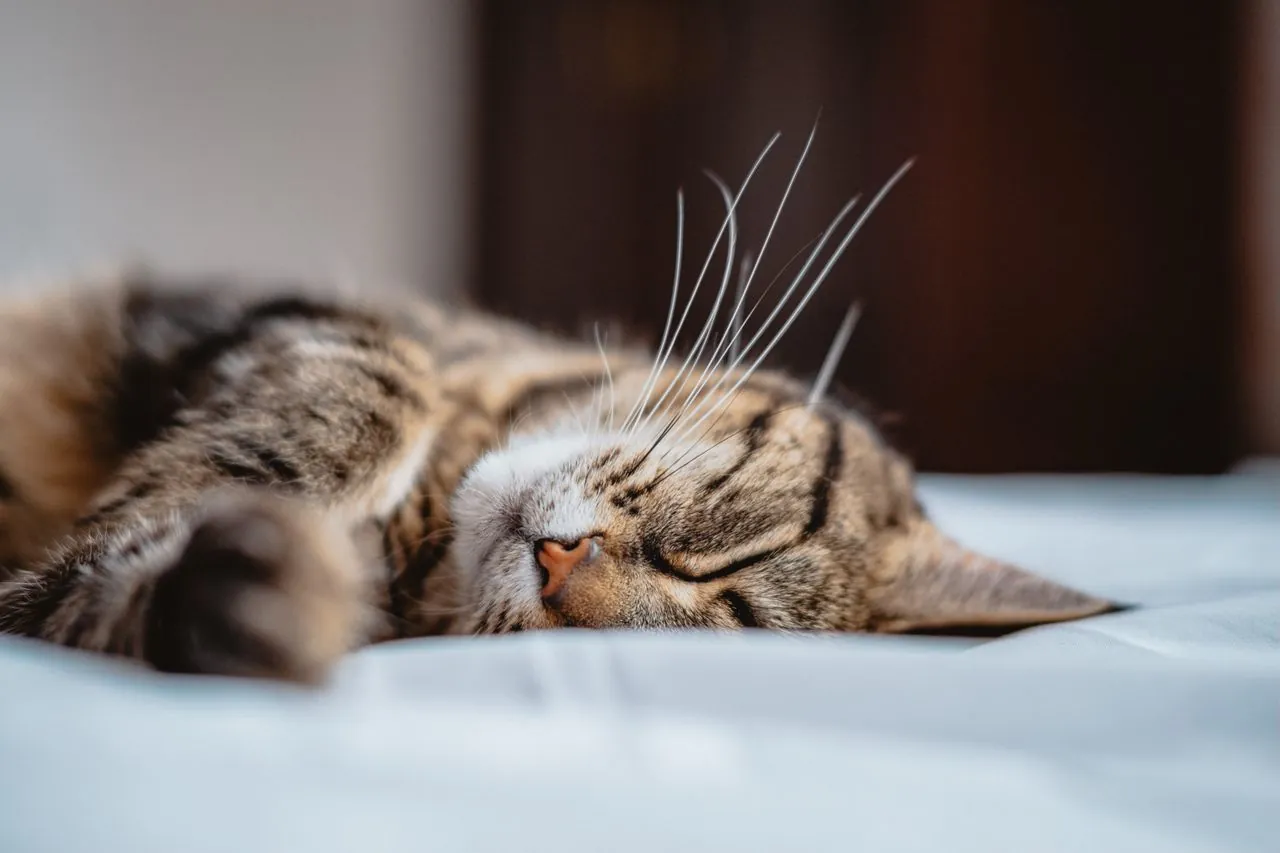
Purring is one of the most recognizable sounds made by the domestic cat and, at the same time, one of the behaviors that invites the most interpretation. Many people automatically connect it with pleasure, calm, or affection. That reading often makes sense: many cats purr while resting, being stroked, or settling near a trusted person. Still, feline behavior science and clinical observation show that purring is not a single message and should not always be read in exactly the same way.
For a beginner caregiver, the key is not to memorize one fixed translation of the sound. The useful skill is learning to read the context. A cat may purr when relaxed, but also when seeking closeness, trying to regulate itself in an uncomfortable situation, or even while going through pain or stress. Understanding why this behavior happens means looking at both the biology that makes it possible and the functions it may serve in the cat's daily life.
What purring is and how it is produced
From a physical perspective, purring is a rhythmic low-frequency vibration that appears during breathing. Although some aspects are still being studied, the most accepted explanation links the sound to a coordinated activation of laryngeal muscles and nearby structures that repeatedly open and close the glottis while the cat inhales and exhales. That fast cycle creates the characteristic vibration people hear and often feel when touching the cat's body.
What matters here is that purring is not produced only during exhalation, as happens with some other vocal sounds. It usually continues through both inhalation and exhalation, which is part of why it feels continuous. That regular pattern helps explain why purring seems steadier than a meow and why it can accompany very different activities, from resting to waiting for food or recovering after an unpleasant experience.
Why science does not assign a single function to it
For a long time, people popularized the idea that purring simply meant happiness. The problem with that interpretation is that it does not fit everything observed in real cats. Some cats purr at the veterinary clinic, during recovery, or when they are clearly tense. That does not automatically mean the sound indicates fear or pain, but it does suggest that purring serves more than one function and can appear in different emotional states.
That is why many current explanations treat purring as a flexible form of communication and self-regulation. In some situations it seems to support social contact and closeness. In others it may be linked to a relatively calm state or to the cat's own attempt to stay regulated. Put simply, purring is not one word with one meaning. It is better understood as a signal whose meaning shifts with the situation in which it appears.
Purring in the relationship between kittens and mother
One of the earliest functions of purring appears during the neonatal stage. Kittens begin to purr very early, and that sound may play a role in bonding with the mother. At a time when vision and movement are still limited, tactile and vibrational signals become especially important. Purring helps maintain proximity and may be part of the sensory exchange inside the nest.
The mother also purrs, and that overlap has led many researchers and observers to think the behavior has relational value from very early development. For a beginner caregiver, this clarifies an important point: purring did not begin only as a response to human petting. It has deeper roots in feline interaction itself, which helps explain why it later appears in many different social contexts.
When purring goes with comfort and calm
The link between purring and wellbeing is not a myth. In daily life that association is often accurate. Many cats purr while kneading a blanket, settling down to sleep, climbing onto a familiar lap, or receiving touch in areas they tolerate well. In those cases, the rest of the body language usually supports a calm reading: half-closed eyes, a loose posture, relaxed tail position, steady breathing, and no visible muscular tension.
That group of signs is more useful than the sound alone. If the cat's body looks soft, the animal chooses to remain nearby, and there are no signs of withdrawal or discomfort, the purring probably belongs to a pleasant experience. The practical lesson is that behavior should be interpreted as a whole package rather than as an isolated signal. That approach reduces common mistakes, especially for people who are new to living with cats.
When it may also appear with stress, fear, or pain
One of the most surprising points for new cat caregivers is that a cat may also purr in unpleasant situations. This is described in some hospitalized, injured, very tense, or heavily handled animals. In these cases, purring should not be read automatically as happiness. Instead, it should prompt a closer look at what is happening around the cat and what the rest of the body is doing.
If the cat has ears pinned back, a stiff body, rapid breathing, very dilated pupils, hiding behavior, unusual vocalizations, or a reduced appetite, the context changes completely. Purring may be appearing alongside self-regulation or as part of an altered physical state. For a beginner caregiver, this distinction matters because it prevents a familiar sound from being mistaken for proof that everything is fine.
The so-called solicitation purr
Some studies and observations suggest that certain cats modify aspects of their purring when they are seeking attention or food. People sometimes refer to this as a solicitation purr because it may include a sound component that stands out to humans. In everyday home life this may show up in cats that approach early in the morning, rub against a person, stay close to the food area, and purr in a way that seems more clearly directed at getting a response.
That does not mean the cat is manipulating people in a human moral sense. The more reasonable reading is that the cat has learned which signals work best in life with people. Just as a meow can take on different shades depending on context, purring can also become part of everyday communication routines. That flexibility helps explain why it does not appear only during rest.
What is known and what is still not fully known
Although purring is a very familiar behavior, not all of its functions are completely settled. There are hypotheses about its role in communication, emotional regulation, and even physiological processes linked to rest and recovery, but those ideas should not be presented as absolute certainties when the evidence remains partial or depends on the observed context. Animal behavior science moves forward partly by correcting explanations that are too simple.
For someone caring for a cat, that has a useful consequence: it is not necessary to solve every biological question in order to make good day-to-day decisions. It is enough to accept that purring is a complex signal and that its meaning changes with environment, individual history, and the rest of the cat's body language. That approach is more cautious and closer to what is genuinely known today.
When it makes sense to pay closer attention
In most cases, purring is part of a normal feline repertoire and does not indicate a problem by itself. Even so, it deserves closer observation if it appears alongside appetite changes, isolation, panting, pain on touch, trouble moving, refusal of usual contact, or a general pattern of behavior that feels different from the cat's baseline. In those situations, the point of interest is not the purr alone, but the cluster of signs that may point to discomfort.
The practical recommendation for beginners is simple: if the cat purrs in a familiar context of rest or contact and everything else looks normal, there is no reason to panic. If the sound appears with marked physical or behavioral changes, a veterinary consultation makes sense. The goal is not to become suspicious of every purr, but to avoid an overly simple reading when the wider context clearly suggests something else.
FAQ
Does purring always mean a cat is happy?
No. Very often it does accompany moments of comfort, rest, or pleasant contact, but it is not an automatic translation of happiness. A cat may purr while comfortably sitting on a person's lap and also in situations involving tension, illness, or discomfort.
That is why the rest of the body language and the surrounding context matter so much. Posture, breathing, ear position, willingness to engage, and changes in the daily routine usually provide more information than the sound alone. Reading purring by itself can easily lead to wrong conclusions.
Do all cats purr in the same way?
Not necessarily. There are individual differences in intensity, noticeable frequency, and the situations in which purring appears. Some cats do it very easily during routine interactions, while others are quieter or reserve it for more specific moments.
In addition, each cat develops its own communication patterns with the people it lives with. For that reason, it is usually more useful to observe how behavior changes within the same individual over time than to compare one cat with another.
Should I worry if my cat purrs at the vet or seems uncomfortable?
That context deserves attention, but it does not automatically mean there is an emergency. What it does mean is that purring alone is not enough to conclude that the cat is fine. In a clinic or another uncomfortable situation, the sound may accompany an attempt at regulation or appear together with bodily tension.
If you also notice loss of appetite, sharp behavior changes, obvious pain, immobility, or respiratory signs, it is reasonable to discuss that with a veterinarian. Useful concern does not come from the purr itself, but from the combination of that sound with other relevant changes.