
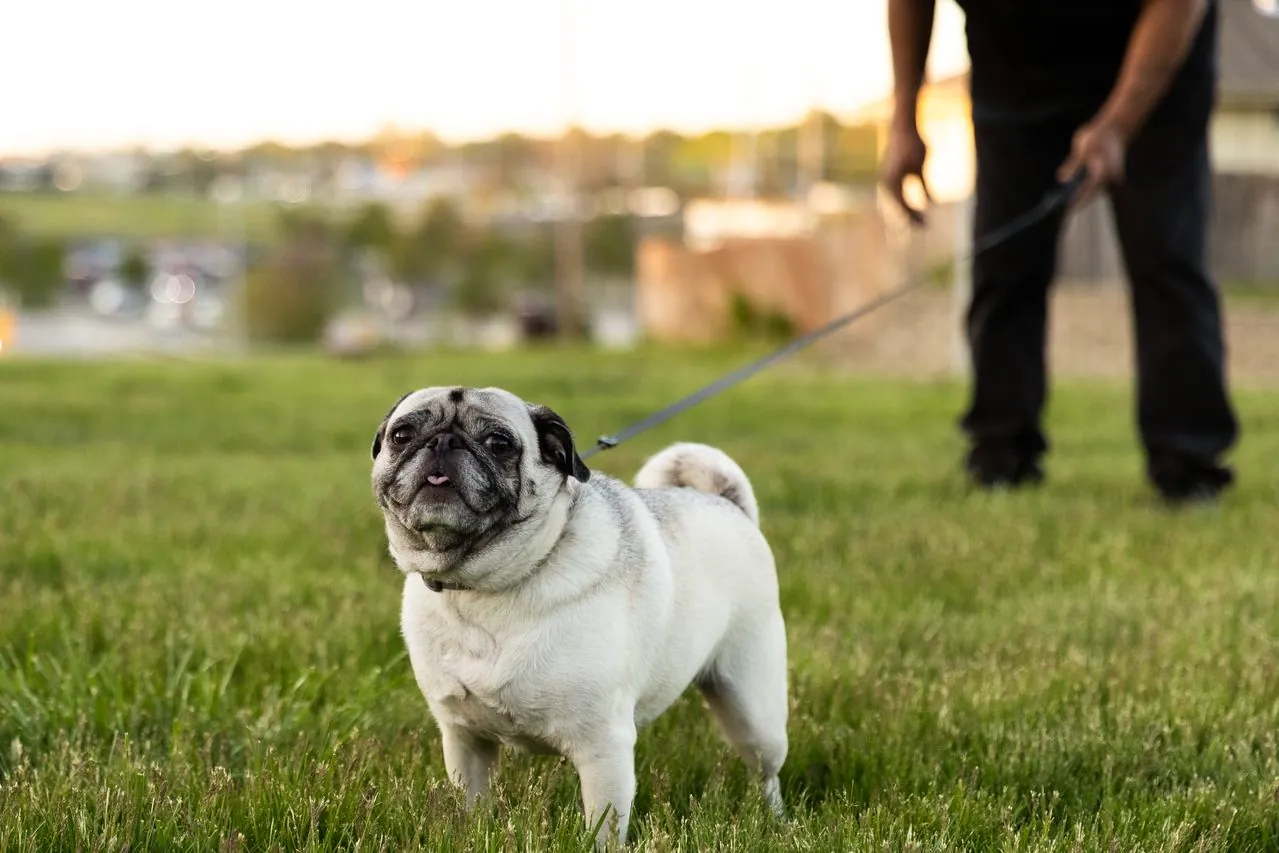
When a dog pulls on the leash, the walk can quickly become tense for both dog and caregiver. The person feels dragged, loses control, or ends up tired too early, while the dog rehearses a level of excitement that makes guidance harder to follow. For a beginner caregiver, this often leads to a common question: if the dog pulls all the time, does that mean the dog is stubborn, too energetic, or walking badly on purpose? In most cases, the answer is much simpler.
Pulling on the leash is a very common behavior because, for many dogs, it works. If the dog wants to reach a scent, a corner, another dog, or simply keep moving, tightening the leash often gets the dog closer to what matters. The problem is not only the force itself, but the learning pattern that becomes stronger through repetition. That is why improving a walk usually does not depend on correcting one isolated pull. It depends on clearly teaching which behavior is actually useful and keeping realistic expectations throughout the process.
Why many dogs pull on the leash
Before trying to change the behavior, it helps to understand why it happens. Many dogs go outside already highly activated: there are new smells, noises, movement, other animals, and anticipation building from before the door even opens. In that context, walking slowly next to a person is not always the dog's most natural choice. If the dog has also learned that pulling gets results, that strategy gains value very quickly.
Lack of specific learning matters too. A dog is not born knowing how to move on a loose leash through distractions, pace changes, and human decisions. For many caregivers, walking may seem intuitive, but for the dog it is a skill that needs practice. Once that is understood, the problem stops looking like constant disobedience and starts to make more sense as a mix of emotion, previous habits, and unclear training.
Start with realistic expectations and comfortable equipment
One of the first steps is to check whether the setting supports learning at all. A leash that is too short, a collar that causes discomfort, a walk that always begins in a rush, or an environment full of stimulation from the first minute can make everything harder. For a beginner, it is usually more useful to think in terms of comfort and handling than miracle tools. A well-fitted harness or a leash that gives a little room may reduce physical strain, but it does not replace actual learning.
Expectations matter just as much. If the goal on day one is a twenty-minute walk through a busy area without a single pull, frustration is likely. It is far more realistic to aim for small wins: leaving home with less excitement, getting a few steps on a loose leash, being able to regain the dog's attention, or ending the walk with less tension than before. This approach does not slow progress down. In many cases, it makes the process easier for both dog and person to understand.
Teach the walking position with low distraction first
Many dogs learn better when a skill is introduced first in a simple environment. Instead of trying to teach everything on the busiest street in the neighborhood, it helps to begin at home, in a quiet yard, or in a calm outdoor area. The goal is not to imitate a perfect walk right away, but to mark which position or distance from the person is appropriate when the leash is loose. That first stage is often clearer when the dog can still think without so much environmental competition.
Short sequences usually help here. The dog can be reinforced for staying near the person, matching pace, or turning together without creating tension. At this stage, clarity matters more than duration. Five or six well-understood repetitions often help more than a long walk full of ambiguous corrections. Once the dog starts anticipating that calm, close walking leads to something useful, the behavior gains value before bigger distractions enter the picture.
Reinforce the behavior you actually want during the walk
One common mistake is focusing only on the moment when the dog is already pulling. Yet much of the learning happens in the moments before that: when the dog looks at the person, loosens the leash voluntarily, slows down, or returns to a more comfortable position. Marking and reinforcing those moments helps the dog understand which pattern is worth repeating. In practical terms, walks improve more when success is rewarded than when the caregiver only reacts to mistakes.
Reinforcement does not always have to be food, although food can make early learning much clearer. It can also mean allowing the dog to move forward, reach a scent, get closer to an interesting area, or simply keep a smooth rhythm while the leash stays loose. What matters is that the dog experiences a clear link between walking with less tension and getting something of value. If every reward comes too late or too inconsistently, the message becomes muddy and pulling keeps its advantage.
What to do when the leash gets tight again
Even with a good foundation, there will be moments when the dog pulls again. That does not mean the learning has failed. More often, it means the distraction temporarily exceeds what the dog can handle, or that the behavior is not yet solid in that setting. Instead of treating each pull as a full return to the starting point, it is more useful to read it as information: perhaps the environment is too difficult, the walk is too long, or the dog needs more practice in an easier version of the exercise.
In practice, it helps if pulling does not immediately achieve the goal. That may mean stopping, changing direction, or waiting for even a small release of tension before moving again. The key is consistency, not harshness. If pulling sometimes allows progress and sometimes does not, the dog keeps testing because the behavior still pays off intermittently. If the dog discovers that movement resumes when the leash loosens, self-control starts to have a more stable meaning.
Common mistakes that slow progress
One of the most common mistakes is asking for too much too soon. Going from no training at all to crowded environments full of dogs, traffic, and intense stimulation makes success unlikely. Another frequent issue is keeping constant tension on the leash even when the dog is not pulling, because that continuous pressure gives very little useful information about when the leash is truly loose. It also complicates the process when the caregiver changes criteria halfway through the walk: sometimes calm walking is requested, but other times pulling is allowed because there is hurry or fatigue.
It also helps not to turn the entire walk into a rigid lesson. A dog needs time to sniff, explore, and move with a reasonable degree of freedom inside clear limits. If the whole outing becomes a chain of corrections, attention requests, or attempts to prevent mistakes, frustration rises and the street becomes harder to manage for everyone. Teaching a dog not to pull does not mean demanding a military march. It means building a walk that leaves room for exploration and more predictable communication.
When professional help makes sense
There are situations where professional support can save a great deal of time and confusion. If the dog pulls with an intensity that is physically hard to manage, if the walk is mixed with fear, reactivity, barking, or freezing, or if the caregiver cannot maintain a consistent plan, an individual assessment can be very valuable. That does not automatically mean the problem is severe. It means that timing, environment, and handling details may need to be adjusted to the specific dog.
Seeking help also makes sense when daily life starts to suffer: walks are avoided, outings become very short because of exhaustion, or tension appears every time the leash comes out. A qualified professional can organize the learning process, adjust the level of difficulty, and notice whether emotional factors beyond leash pulling are involved. In many cases, that guidance does not replace the caregiver's daily work, but it makes it clearer and far more sustainable.
FAQ
How long does it take a dog to learn loose-leash walking?
There is no single timeline, because progress depends on the dog's age, previous habits, walking environment, and the caregiver's consistency. A dog that has spent months or years getting results by tightening the leash usually does not change in a matter of days. The first improvements are often small: fewer pulls in certain parts of the walk, a better ability to return to a calmer position, or more success on short and simple routes.
It also helps to remember that learning to walk without pulling is not a perfectly linear process. Some days will go better than others depending on fatigue, weather, time of day, or stimulation level. Measuring progress by overall trends, rather than by one isolated walk, usually gives a more accurate picture.
Is it better to let the dog run and get tired before leash training?
That depends on the dog and the context, but in general it is not a good idea to assume that fatigue alone will solve the behavior. Some dogs, when they go out already highly activated or overstimulated, actually pull more. What usually helps most is finding a balance between meeting movement needs and starting training while the dog can still pay attention and learn.
In some cases, a few minutes of calm sniffing, a quieter location, or a more predictable start to the outing works better than trying to drain all energy first. The goal is not to wear the dog out. The goal is to make leash walking a skill the dog can realistically practice.
What should I do if my dog walks well at first and then starts pulling later?
That pattern is quite common and usually suggests that the dog can self-regulate for part of the outing, but loses that capacity when excitement, fatigue, or stimulation increases. It may also happen because the beginning of the walk is more structured and the person gradually relaxes the criteria without noticing. Rather than treating this as a contradiction, it helps to use it to adjust duration and difficulty more precisely.
Shortening the route, adding more pauses, reinforcing before pulling appears, or choosing times of day with fewer distractions can help a great deal. If the change always happens around the same point in the walk, there is probably useful information there about what the dog still cannot manage well.